

Golden Falcon Energy Logo
Sulphur Market 2026: Global Prices, Supply, Demand, FOB & CIF Trading Guide
Sulphur

Sulphur Market 2026: Global Prices, Supply, Demand, FOB & CIF Trading Guide

A detailed technical analysis of the global sulphur market in 2026, covering production sources, supply and demand dynamics, price drivers, FOB and CIF trading structures, major hubs and the central role of the Middle East.

August 15, 202628 min read
Few commodities occupy as paradoxical a position in global trade as sulphur. It is, in physical terms, a low-value byproduct — a waste stream that refineries and gas processing plants are legally obligated to remove from hydrocarbons before they can be sold or burned. Yet in 2026, sulphur has become one of the tightest, most strategically watched commodities in the entire industrial and agricultural supply chain, with prices in some import markets more than doubling within a single year. Behind this apparent contradiction lies a structural reality that every trader, importer, and industrial buyer needs to understand: sulphur supply is inelastic, geographically concentrated, and almost entirely dependent on decisions made in the oil and gas sector rather than in the sulphur market itself. Demand, meanwhile, has been expanding on two fronts simultaneously — the century-old backbone of phosphate fertiliser production, and a newer, faster-growing pull from battery-grade chemicals and hydrometallurgical metal processing. This report examines how the global sulphur market actually functions in 2026: where the material physically originates, which countries and companies control the seaborne trade, what specifically moves prices from one quarter to the next, and how FOB and CIF pricing structures translate a low-cost Gulf byproduct into a premium landed commodity in Mumbai, Casablanca, or Rotterdam. It is written for trading desks, procurement managers, and fertiliser and chemical producers who need an operational understanding of the market rather than a general introduction to sulphur chemistry.

1. What Is Sulphur and Where Does It Come From?

Sulphur exists in nature in several forms — native deposits, sulphide ores, gypsum, and dissolved in crude oil and natural gas as hydrogen sulphide (H₂S) and organic sulphur compounds. Until the mid-twentieth century, most of the world's sulphur came from the...

1. What Is Sulphur and Where Does It Come From?
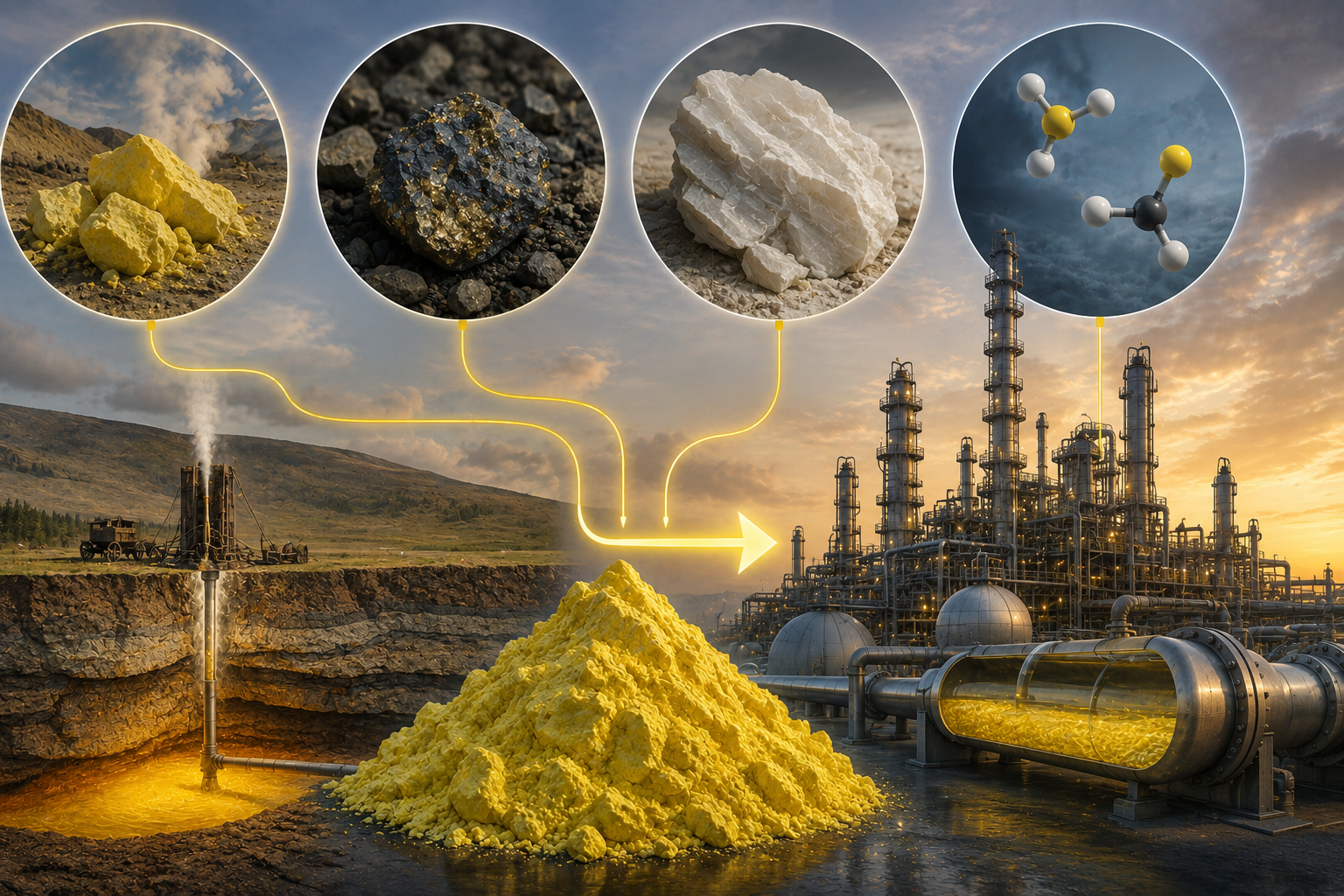
Sulphur exists in nature in several forms — native deposits, sulphide ores, gypsum, and dissolved in crude oil and natural gas as hydrogen sulphide (H₂S) and organic sulphur compounds. Until the mid-twentieth century, most of the world's sulphur came from the Frasch process, which involved mining native sulphur deposits, principally in the United States and Poland, using superheated water to melt underground sulphur and pump it to the surface. That era is effectively over. Today, roughly 90% of the world's sulphur supply is recovered sulphur — a byproduct of removing sulphur compounds from crude oil, natural gas, and bitumen during refining and processing, primarily to meet environmental regulations limiting sulphur dioxide emissions and to protect downstream catalysts and pipelines from corrosion. Three industrial processes generate the overwhelming majority of the world's sulphur supply, and understanding each is essential to understanding why the market behaves the way it does. Sulphur Recovery at Oil Refineries Sulphur recovery at oil refineries takes place through hydrodesulphurisation units, where hydrogen is used to strip sulphur out of crude oil fractions such as diesel and jet fuel, converting it into hydrogen sulphide gas. This H₂S is then routed through a Claus process unit, which converts it into elemental sulphur, typically in molten form, that is either exported directly as liquid sulphur to nearby industrial consumers or solidified into prilled, granular, or block form for storage and export. The volume of sulphur a refinery produces is a direct function of two variables: the sulphur content of the crude oil being processed (sour versus sweet crude) and the refinery's overall throughput. Neither variable is set with sulphur output in mind — refiners optimise for fuel yields and margins, not for sulphur production, which means sulphur supply from refineries is a passive byproduct that refiners have little incentive to increase or decrease independently of their core fuel economics. Natural Gas Processing Natural gas processing is, in many ways, an even larger and more geographically concentrated source of sulphur than oil refining, particularly in the Middle East. Sour natural gas fields — those with high concentrations of H₂S — require extensive gas sweetening before the gas can be transported or liquefied for LNG export. Qatar's North Field, Saudi Arabia's onshore and offshore sour gas developments, and the UAE's Habshan and Shah gas fields are among the most sulphur-rich gas processing complexes in the world. Because Gulf gas producers have spent the past two decades aggressively expanding LNG and domestic gas supply capacity to meet both export contracts and rising local power and petrochemical demand, sulphur recovery volumes in the region have grown almost as a side effect of gas sector expansion, independent of sulphur market conditions. Bitumen and Heavy Oil Upgrading Bitumen and heavy oil upgrading, concentrated in Alberta, Canada, and to a lesser extent in Venezuela, represents a third significant source. Oil sands bitumen is extremely sulphur-rich, and upgrading it into synthetic crude generates large volumes of recovered sulphur, much of which is stockpiled in solid block form at upgrader sites before being shipped, primarily through the port of Vancouver, to Asian and Latin American buyers. The critical structural point that follows from all three sources is this: sulphur supply is a function of energy sector decisions — refinery utilisation rates, LNG expansion plans, oil sands production economics — not of sulphur demand or price. When fertiliser producers need more sulphur, they cannot simply order refineries to process more crude or gas processors to expand capacity. This is what economists call inelastic supply, and it is the single most important structural feature explaining sulphur's price volatility.

2. Global Sulphur Supply

Global sulphur production in 2025 reached approximately 71.4 million tonnes, with industry forecasts projecting the market to expand to nearly 95 million tonnes by 2034 at a compound annual growth rate of roughly 3%. But aggregate production figures obscure a...
2. Global Sulphur Supply
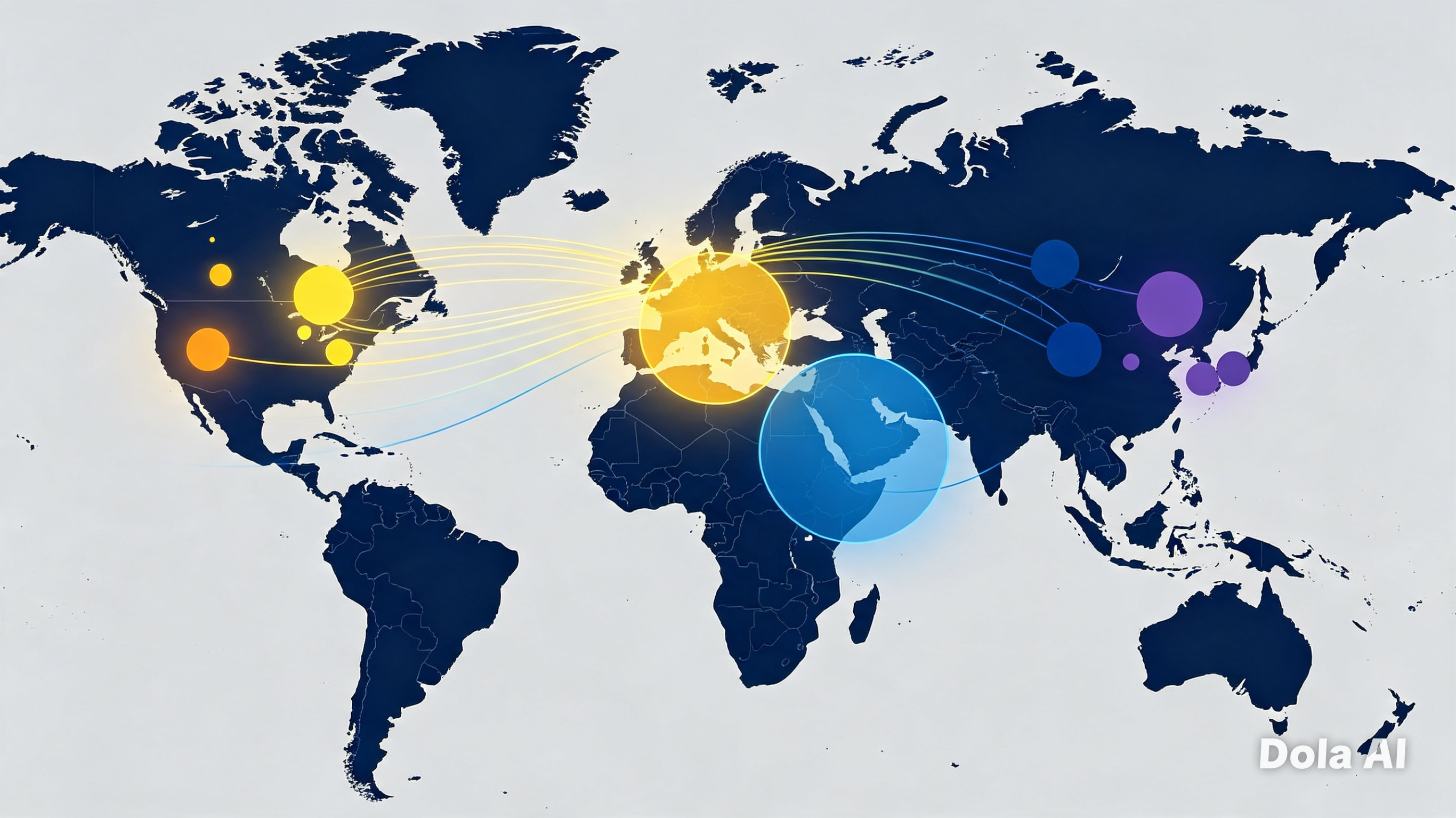
Global sulphur production in 2025 reached approximately 71.4 million tonnes, with industry forecasts projecting the market to expand to nearly 95 million tonnes by 2034 at a compound annual growth rate of roughly 3%. But aggregate production figures obscure a critical imbalance: production is heavily concentrated in a small number of energy-exporting regions, while consumption is concentrated in a largely different set of agricultural and industrial economies. This mismatch is what makes sulphur, unlike many industrial minerals, fundamentally a seaborne trade commodity rather than a domestically consumed one in most producing regions. China holds a unique dual position in the global sulphur balance. It is simultaneously the world's largest producer, accounting for roughly 18% of global output at approximately 18 million tonnes annually, and the world's largest consumer, accounting for roughly 31% of global volume at around 34 million tonnes. This structural deficit — domestic production covering only about half of domestic demand — makes China the single largest importer of sulphur by value in the world, importing well over a billion dollars' worth of the commodity annually even before accounting for the sulphur embedded in imported sulphuric acid and phosphate rock processing chains. The Persian Gulf states — Saudi Arabia, Qatar, the United Arab Emirates, Kuwait, and, when sanctions and geopolitics permit, Iran — together account for roughly 35–40% of global sulphur production and are estimated to supply approximately half of all seaborne sulphur trade. This is the figure that matters most to international buyers: while the Gulf's share of total global production is significant but not overwhelming, its share of the tradable, exportable surplus is dominant, because Gulf domestic consumption of sulphur is minimal relative to production. Virtually every tonne of sulphur recovered from Qatari and UAE gas processing, and a large share of Saudi Arabian output, is destined for export. Beyond China and the Gulf, several other regions play meaningful supply roles. Canada, driven by Alberta oil sands upgraders, remains a major exporter to Asia-Pacific and Latin American markets via the port of Vancouver. Russia, historically a significant exporter through Black Sea and Baltic terminals, has faced ongoing uncertainty around refinery capacity recovery following sanctions-driven disruptions to its energy sector, with 2026 industry assessments suggesting Russian sulphur output would struggle to normalise in the first half of the year. Kazakhstan has emerged as an increasingly important secondary Central Asian supplier, particularly to Chinese and Moroccan buyers, drawing on sulphur recovered from its Tengiz and Karachaganak oil and condensate fields. The United States remains a substantial producer from Gulf Coast refineries, though it is a comparatively minor net exporter given the scale of its own downstream chemical and fertiliser industry's sulphur appetite. On the incremental supply side, industry forecasts for 2026 pointed to China adding approximately 400,000 tonnes of new recovered sulphur capacity and the Middle East adding roughly 2.1 million tonnes of incremental production, largely tied to ongoing gas processing expansions. However, these additions have proven insufficient to meaningfully loosen the market, both because underlying demand growth has outpaced them and because a series of acute supply disruptions in the first half of 2026 removed far more tonnage from the seaborne market than any single year's planned capacity growth could offset.

3. Sulphur Demand in 2026

Sulphur's demand base has historically rested on a single overwhelming pillar: sulphuric acid production, which in turn feeds primarily into phosphate fertiliser manufacturing. That remains true in 2026, but the demand picture has become considerably more com...
3. Sulphur Demand in 2026
Sulphur's demand base has historically rested on a single overwhelming pillar: sulphuric acid production, which in turn feeds primarily into phosphate fertiliser manufacturing. That remains true in 2026, but the demand picture has become considerably more complex, with a second, faster-growing demand vector reshaping trade flows and price formation. Sulphuric Acid Production Sulphuric acid production remains the largest single end use of elemental sulphur, consuming an estimated 60% or more of global sulphur supply once converted through the contact process. Sulphuric acid itself is not primarily a traded commodity for its own sake; rather, it functions as the essential processing reagent for several major industrial chains, chief among them phosphate rock digestion. Roughly 85% of global sulphuric acid output feeds into fertiliser production, principally the conversion of phosphate rock into phosphoric acid, which is the precursor for diammonium phosphate (DAP), monoammonium phosphate (MAP), and other phosphate fertiliser products essential to global grain, oilseed, and specialty crop agriculture. The Phosphate Fertiliser Industry The phosphate fertiliser industry is therefore the ultimate demand anchor for the sulphur market, and its consumption patterns are strongly seasonal, tied to planting cycles in the Northern and Southern Hemispheres. Spring planting season procurement in India, ahead of the kharif cropping cycle, and rabi season buying in the autumn, create recurring demand spikes that interact with — and in 2026, have collided directly with — supply-side disruptions to produce unusually sharp price movements. Morocco's OCP Group, the world's largest phosphate fertiliser producer and exporter, operates an integrated production chain with total phosphate fertiliser capacity of approximately 12 million tonnes per year, requiring an estimated 5–6 million tonnes of sulphur annually, sourced historically from Qatar, Saudi Arabia, and the UAE, supplemented by Kazakh and Canadian cargoes. A single producer of this scale illustrates how concentrated and inflexible large portions of sulphur demand actually are: OCP cannot easily substitute away from sulphuric acid in its production process, and its offtake commitments with Gulf suppliers are typically structured as long-term contracts rather than spot purchases. Base and Precious Metal Processing Base and precious metal processing represents the second-largest traditional demand category, with sulphuric acid used extensively in copper leaching (particularly solvent extraction-electrowinning, or SX-EW, operations common in Chile), as well as in uranium, nickel, and zinc processing. The New Energy Sector The newest and most consequential demand driver in the 2025–2026 market cycle has been the new energy sector, specifically lithium iron phosphate (LFP) battery cathode production in China and nickel hydrometallurgical processing in Indonesia. LFP battery chemistry requires phosphate as a core input, and the rapid buildout of Chinese LFP cathode capacity to supply both domestic and export electric vehicle and energy storage markets has created a new, fast-growing pull on the same phosphate-sulphuric acid supply chain that fertiliser producers depend on. Simultaneously, Indonesia's rapid expansion of high-pressure acid leach (HPAL) nickel processing capacity, feeding battery-grade nickel intermediates, consumes substantial volumes of sulphuric acid, indirectly tightening the elemental sulphur balance further. Industry analysts characterised 2025 as a period in which the sulphur market experienced what has been described as an independent price surge driven specifically by this new energy demand, distinct from and additive to traditional fertiliser season cycles, pushing prices to historic highs even before the acute supply shocks of early 2026 occurred. The combined effect of a maturing fertiliser demand base and a rapidly scaling battery and metals-processing demand base means that sulphur consumption growth in 2026 has structurally outpaced the modest, energy-sector-dependent growth in recovered sulphur supply — a supply-demand gap that most industry forecasters expect to widen further rather than close in the near term.

4. What Determines Sulphur Prices?

Sulphur pricing is set through a combination of structural fundamentals and acute, often geopolitical, shocks, and 2026 has provided a textbook illustration of both operating simultaneously. Six factors dominate price formation. Oil and Gas Sector Output Dec...
4. What Determines Sulphur Prices?
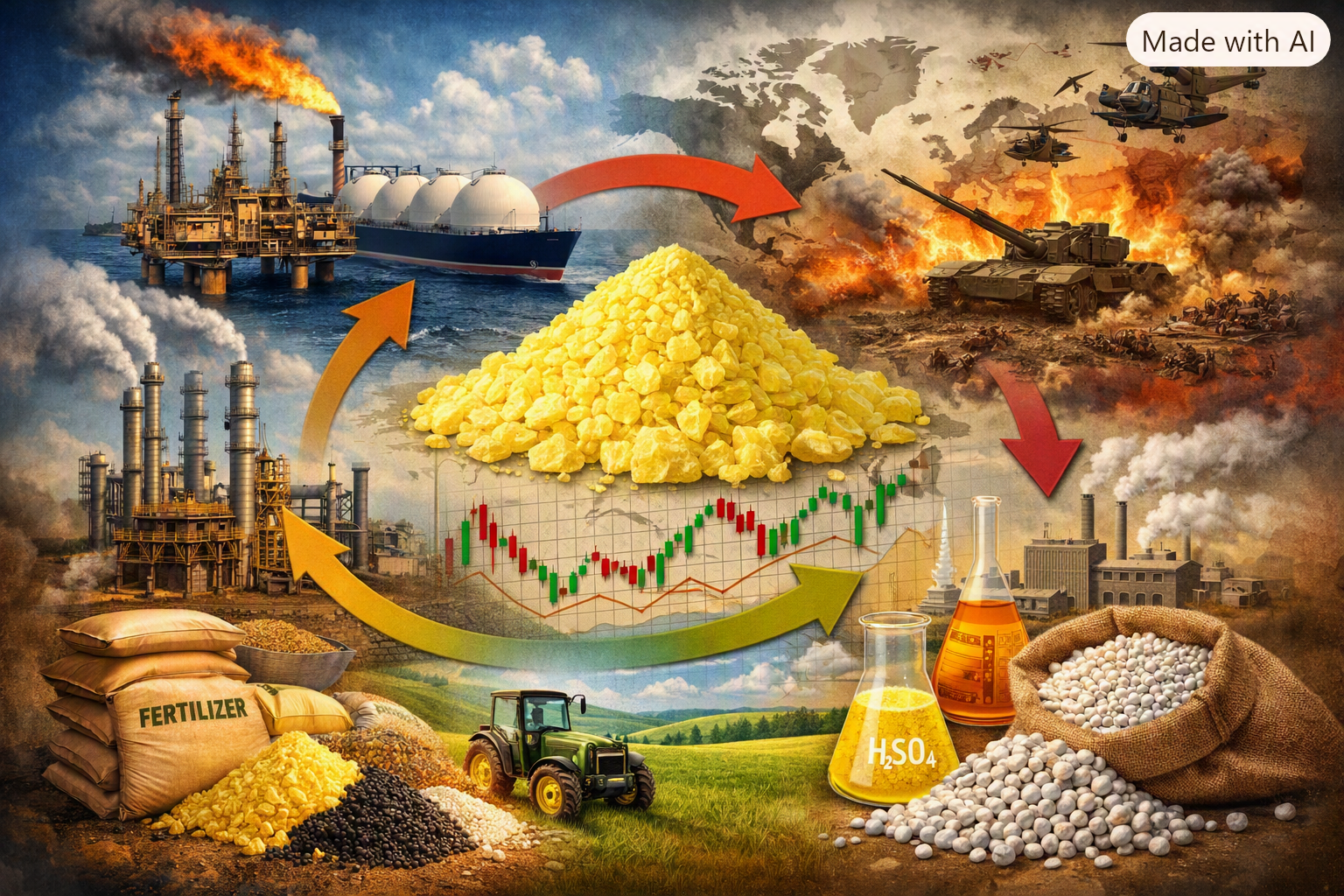
Sulphur pricing is set through a combination of structural fundamentals and acute, often geopolitical, shocks, and 2026 has provided a textbook illustration of both operating simultaneously. Six factors dominate price formation. Oil and Gas Sector Output Decisions Because sulphur is a mandated byproduct rather than a primary product, its supply moves with refinery utilisation rates and gas processing throughput, which in turn are driven by crude oil and LNG market economics rather than sulphur demand. A refiner running at reduced utilisation due to weak fuel margins will produce less sulphur regardless of how tight the sulphur market is. Fertiliser and Sulphuric Acid Sector Demand Cycles Spring and autumn planting-season procurement in South Asia, North Africa, and Latin America creates predictable seasonal demand surges that interact with whatever supply conditions prevail at the time. Freight, Insurance and Shipping Costs Because sulphur is overwhelmingly a seaborne-traded commodity, the cost of moving it from Gulf, Canadian, or Black Sea export terminals to importing ports is a major and highly volatile component of landed cost. This became acutely visible in early 2026: following a series of tanker attacks in the southern Gulf shipping corridor at the end of March, attributed by Western intelligence assessments to pro-Iranian forces, insurance underwriters raised war-risk premiums by roughly 700%, and Handymax-class freight rates on Middle East routes spiked from around 18,000 dollars per day to approximately 65,000 dollars per day within a matter of weeks. Geopolitical Disruption to Gulf Export Routes The dominant price event of the 2026 market year has been the partial closure of the Strait of Hormuz amid the escalation of tensions in the broader Iran-related regional conflict. This disruption is estimated to have interrupted the flow of roughly 4 million tonnes of sulphur per year — approximately 18% of total global seaborne sulphur trade — originating from Qatari, UAE, and Iranian export terminals. Saudi Arabia and the UAE temporarily suspended sulphur export shipments while alternative routing via the Red Sea was assessed, a corridor itself already under pressure from Houthi attacks on shipping originating from Yemen. The price impact was immediate and severe: spot granular sulphur FOB Arabian Gulf reportedly jumped from a range of roughly 80–90 dollars per tonne to approximately 160 dollars per tonne within the first week of April 2026 alone, according to trade press reporting citing Argus Media price assessments. Chinese Trade Policy In a separate but compounding development, China announced on 10 April 2026 a full export ban on sulphuric acid through August 2026, replacing what had previously been an annual export quota of roughly 700,000 tonnes with a complete export halt. Because China is the world's largest sulphuric acid exporter, supplying Chilean copper SX-EW operations, Indonesian nickel HPAL processing, and Saudi Arabian and Indian fertiliser and industrial users, this policy shift forced several major acid-consuming industries to seek alternative supply simultaneously with the Hormuz disruption, amplifying stress across the entire sulphur-to-sulphuric-acid-to-phosphate value chain. Saudi Arabia, which had historically imported sulphuric acid from India via the port of Ras al-Khair, found that route effectively blocked by the Strait of Hormuz closure and was forced to rely on irregular alternative shipments through the port of Yanbu on the Red Sea coast. Regional Demand Competition With Middle Eastern export volumes constrained, buyers in China, India, and Southeast Asia found themselves competing directly for a shrunken pool of available cargoes, a dynamic that trade analysts noted was itself an independent price-supportive factor distinct from the freight and insurance cost increases. Price Movements Through 2026 The cumulative effect of these factors on regional benchmark prices through the first half of 2026 was substantial. Global average sulphur prices rose from approximately 0.168 dollars per kilogram to 0.383 dollars per kilogram over the course of 2025 alone, a gain of roughly 128%, before continuing to climb further in the first quarter of 2026. Indian import prices, historically the highest-cost major import market due to freight distance and duty structures, rose from around 0.18 dollars per kilogram in the first quarter of 2025 to roughly 0.52 dollars per kilogram by the fourth quarter, a 177.8% increase, before climbing further to approximately 0.64 dollars per kilogram by the first quarter of 2026. Chinese domestic prices averaged around 0.60 dollars per kilogram in the first quarter of 2026, up 20% from the prior quarter. United States prices, more insulated by strong domestic refinery and gas processing supply, still rose to roughly 0.28 dollars per kilogram in the first quarter of 2026, up nearly 22% quarter-on-quarter, illustrating that even relatively supply-secure markets were not immune to the global tightening. Saudi Arabian FOB export prices rose from roughly 0.28 dollars per kilogram in the fourth quarter of 2025 to about 0.31 dollars per kilogram in the first quarter of 2026, and UAE FOB Jebel Ali granular sulphur pricing was reported to have risen a further 5.5% in March 2026 alone. Industry forecasters expected the global average to remain in a range of roughly 0.36–0.52 dollars per kilogram for the remainder of 2026, with continued elevated pricing contingent on the persistence of Middle East supply disruption and sustained new energy sector demand. Sulphuric acid pricing moved in close correlation, with the global average rising from roughly 235 to 275 dollars per tonne, a gain of 17%, with forecasts for the remainder of 2026 pointing to a range of approximately 270–320 dollars per tonne, driven by continued sulphur feedstock tightness layered on top of strong metals-leaching demand, with Chile commanding the firmest regional premium due to copper-leaching demand and import dependency, the United States trading close behind due to tight domestic smelter byproduct supply, Morocco occupying a middle tier reflecting its enormous phosphate-fertiliser processing base, and China remaining the most affordable major market on the strength of its large domestic production base even after posting the steepest percentage price gain among the four.

5. Major Sulphur Trading Hubs

The global seaborne sulphur trade is organised around a relatively small number of major export and import hubs, each with distinct logistical, contractual, and pricing characteristics. The Middle East functions as the market's dominant export hub, anchored ...
5. Major Sulphur Trading Hubs
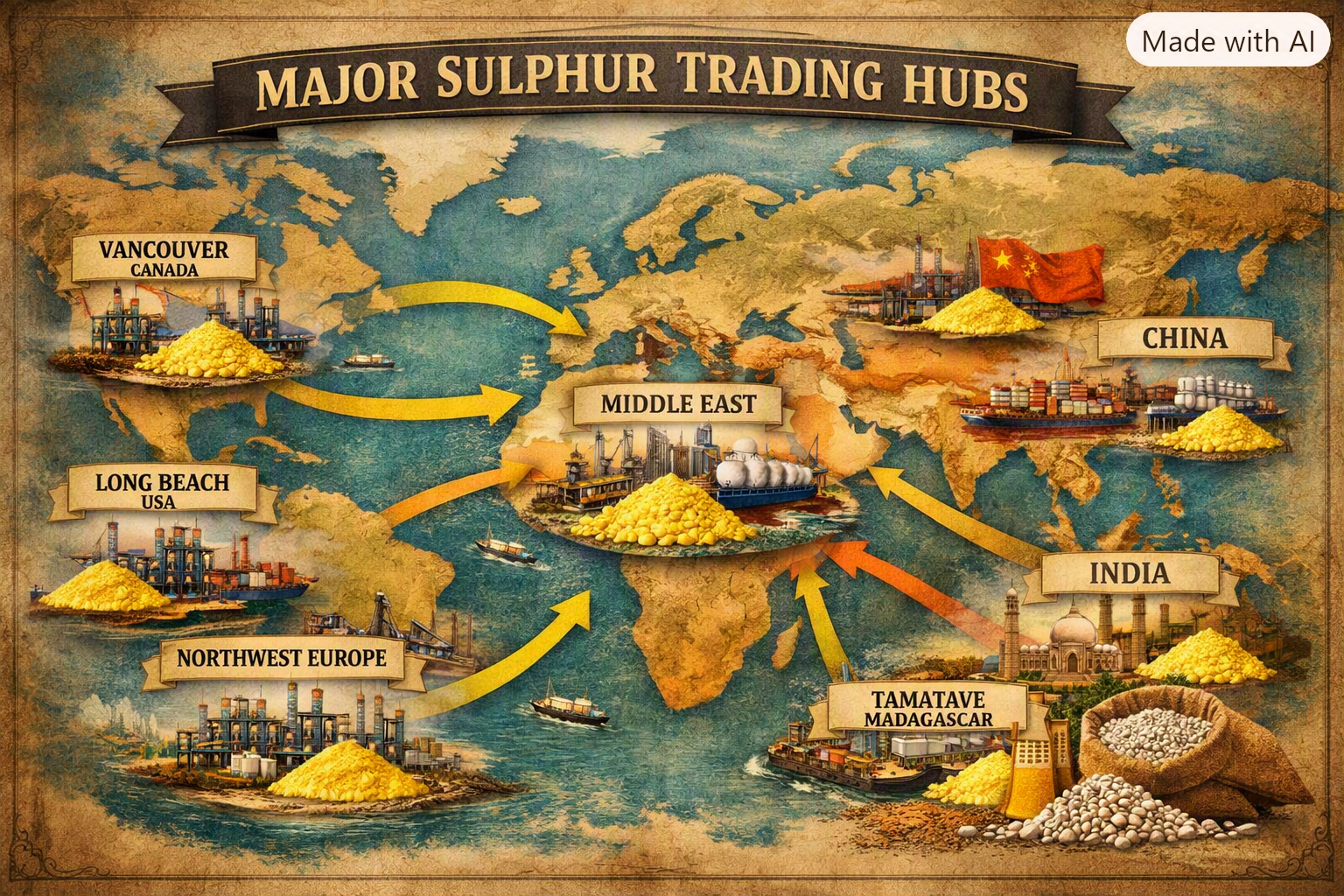
The global seaborne sulphur trade is organised around a relatively small number of major export and import hubs, each with distinct logistical, contractual, and pricing characteristics. The Middle East functions as the market's dominant export hub, anchored by Ras Laffan and Ras Tanura-area terminals in Qatar, Jubail and Ras al-Khair in Saudi Arabia, and Jebel Ali and Ruwais in the UAE. Middle East FOB pricing serves as the global reference benchmark against which most other regional prices are assessed, and the majority of the region's granular sulphur output moves under a mix of long-term offtake contracts, particularly with Moroccan and Indian phosphate producers, and spot cargoes sold into whichever destination market offers the strongest netback at the time. China operates as both a major production centre and, by a wide margin, the world's largest single import market by volume, drawing cargoes from the Middle East, Canada, Russia, and increasingly Kazakhstan to close its substantial domestic supply-demand gap, feeding both its phosphate fertiliser complex and its rapidly expanding LFP battery cathode manufacturing base. India stands as the most import-dependent of the major consuming markets and, as the 2026 data illustrates, typically the most price-volatile, given its heavy reliance on Middle East-origin cargoes routed through the Strait of Hormuz and its concentrated seasonal procurement patterns tied to kharif and rabi planting cycles. Qatar, the UAE, Oman, Kuwait, and Saudi Arabia collectively account for the overwhelming majority of India's sulphur import supply, with Qatar and the UAE alone typically representing more than half of total import value. North Africa, dominated by Morocco's OCP Group, functions as a major, structurally stable import hub given its scale and long-term contractual relationships with Gulf suppliers, though it remains exposed to the same freight and geopolitical disruption risks affecting all Gulf-origin cargo flows. The Mediterranean and Europe represent a comparatively smaller but import-dependent demand centre, reliant on a mix of Black Sea, Baltic, and Middle Eastern supply, and correspondingly exposed to Russian supply uncertainty and Red Sea and Suez routing risk. North America, chiefly through the port of Vancouver for Canadian oil sands-derived block sulphur and U.S. Gulf Coast terminals for refinery-recovered sulphur, functions as a secondary but strategically important export hub, particularly for Asia-Pacific and Latin American buyers seeking to diversify away from Middle East-origin supply during periods of Gulf disruption — a role that became especially visible in the first quarter of 2026, when international buyer procurement measurably redirected toward Vancouver-origin cargoes as Middle Eastern availability tightened.

6. FOB vs CIF Sulphur Pricing

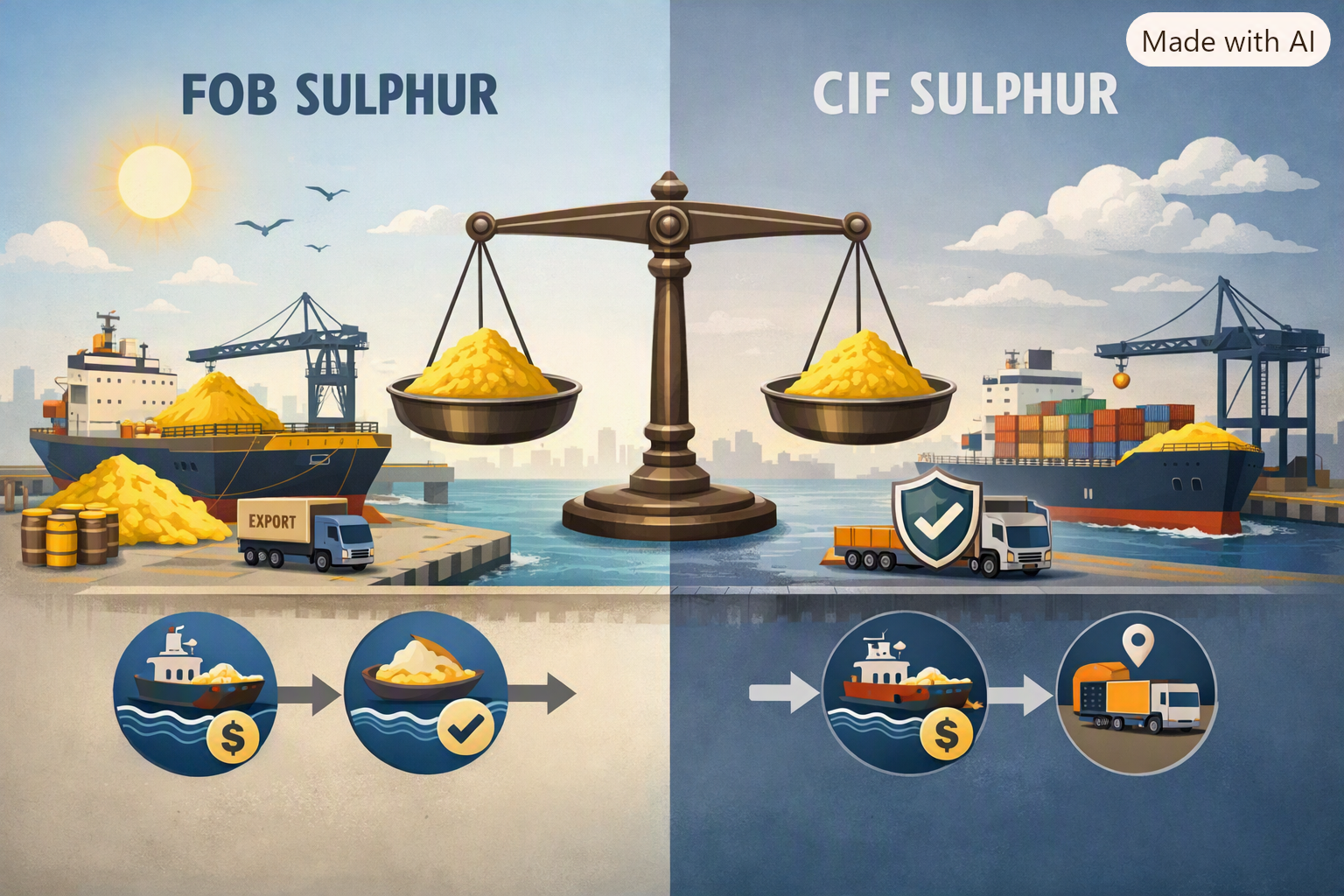
Understanding the difference between FOB and CIF pricing is essential to interpreting sulphur market data correctly, because headline prices reported for different markets are frequently not directly comparable unless the trade term is clearly specified. FOB...
6. FOB vs CIF Sulphur Pricing
Understanding the difference between FOB and CIF pricing is essential to interpreting sulphur market data correctly, because headline prices reported for different markets are frequently not directly comparable unless the trade term is clearly specified. FOB (Free on Board) pricing refers to the value of the cargo at the point of loading at the export terminal — for example, FOB Ras Laffan or FOB Jebel Ali — and reflects the seller's production and terminal handling costs plus their margin, but excludes ocean freight, marine insurance, and any costs incurred after the cargo passes the ship's rail. FOB prices are the appropriate benchmark for comparing the underlying competitiveness of different export origins, since they strip out the destination-specific variables of freight distance and insurance risk. CIF (Cost, Insurance, and Freight) and the closely related CFR (Cost and Freight) pricing reflect the total landed cost at the destination port, incorporating the FOB value plus ocean freight and, in the case of CIF, marine insurance, up to the point of discharge at the buyer's port. CIF and CFR prices are what importing industrial buyers actually pay and are the figures most relevant to procurement budgeting, but they are inherently more volatile than FOB prices because they embed freight rate and insurance premium fluctuations on top of underlying commodity price movements. The gap between FOB and CIF/CFR pricing is not a fixed markup; it expands and contracts with shipping market conditions, and 2026 has provided an extreme illustration of how large that gap can become during a geopolitical shipping crisis. When Handymax freight rates on Gulf routes rose from roughly 18,000 to 65,000 dollars per day and war-risk insurance premiums increased by approximately 700% following the tanker attacks of late March 2026, the freight and insurance component of CIF pricing into India and other Asian destinations expanded dramatically relative to the underlying FOB Gulf price, meaning landed cost inflation for Indian and Chinese buyers substantially outpaced the already sharp increase in FOB export prices. This is precisely why Indian CFR Paradip pricing on Qatar-origin cargoes rose even faster in percentage terms than Saudi Arabian or Qatari FOB export prices over the same period — the freight and insurance component of the trade was itself a major independent source of price inflation, layered on top of the underlying commodity tightness. For trading and procurement purposes, this distinction matters practically in several ways. Buyers negotiating term contracts need to specify clearly whether pricing is FOB origin, with the buyer arranging and bearing the cost and risk of shipping, or CIF/CFR destination, with the seller or an intermediate trader arranging freight and, in the case of CIF, insurance. During periods of freight market volatility such as the first half of 2026, FOB purchases expose the buyer directly to freight rate risk but may offer more transparent pricing relative to the underlying commodity market, while CIF purchases transfer that freight risk to the seller or trader, typically at a premium reflecting the risk being assumed.

7. Granular vs Lump Sulphur

Elemental sulphur is traded and consumed in several distinct physical forms, and the choice of form has meaningful implications for handling, storage, transport cost, and end-use suitability. Molten or Liquid Sulphur Molten or liquid sulphur is sulphur in i...

Elemental sulphur is traded and consumed in several distinct physical forms, and the choice of form has meaningful implications for handling, storage, transport cost, and end-use suitability. Molten or Liquid Sulphur Molten or liquid sulphur is sulphur in its as-produced form, typically piped directly from a Claus recovery unit to an adjacent sulphuric acid plant or loaded into insulated, heated rail or road tankers for short-distance transport to nearby industrial consumers. It requires continuous temperature maintenance to prevent solidification and is generally impractical for long-distance seaborne trade, making it primarily relevant to integrated industrial complexes located near refineries or gas processing plants. Prilled Sulphur Prilled sulphur is produced by spraying molten sulphur through a prilling tower, where it cools and solidifies into small, roughly spherical pellets, typically a few millimetres in diameter. Prilling is a relatively low-cost solidification method and produces a product that is reasonably easy to handle in bulk, though prilled sulphur tends to generate more dust during handling and transport than granular sulphur, which has raised increasing concern among terminal operators and buyers regarding both product loss and workplace safety and environmental compliance around sulphur dust. Granular Sulphur Granular sulphur is produced through more sophisticated solidification and compaction processes designed to create larger, more uniform, and more mechanically robust particles than simple prilling. Granular sulphur is generally preferred in modern seaborne trade because it produces significantly less dust during loading, transport, and discharge, reduces product loss, and is easier to handle safely at port terminals — advantages that have made it the dominant traded form for most Gulf, Canadian, and North American export cargoes referenced in current market pricing, including the FOB Jebel Ali, FOB Ras Laffan, and FOB Vancouver benchmarks discussed earlier in this report. Lump or Block Sulphur Lump or block sulphur refers to solid sulphur cast or accumulated in large blocks, historically common at Canadian oil sands upgraders, where molten sulphur is poured into open-air storage pads and allowed to solidify into massive blocks that are later mechanically broken up for shipment. While lump sulphur avoids the capital cost of dedicated prilling or granulation equipment, it requires energy-intensive crushing before it can be loaded onto vessels or transported to end users, and it generates substantially more dust and handling loss than granular product, which has made granular and, to a lesser extent, prilled forms increasingly dominant in international seaborne trade even as some legacy block stockpiles remain in producing regions. For fertiliser producers and industrial buyers, the practical implication is that granular sulphur typically commands a modest quality premium over prilled or lump material in international trade, reflecting its lower handling losses and reduced environmental and safety liabilities at port and plant, though the differential can narrow considerably during periods of acute market tightness, such as that experienced in the first half of 2026, when buyers have shown willingness to accept less-preferred forms simply to secure available tonnage.

8. The Role of the Middle East in Global Sulphur Trade

No region shapes the global sulphur market more directly than the Persian Gulf, and the events of 2026 have only reinforced how central — and how exposed — this concentration of supply has become. Qatar Qatar is among the most significant single-country exp...

No region shapes the global sulphur market more directly than the Persian Gulf, and the events of 2026 have only reinforced how central — and how exposed — this concentration of supply has become. Qatar Qatar is among the most significant single-country exporters of sulphur in the world, with sulphur recovery driven overwhelmingly by North Field gas processing operations feeding the country's LNG export industry. Qatari sulphur exports flow primarily to Singapore, Switzerland-based trading houses, and India, with Ras Laffan functioning as the principal export terminal and FOB Ras Laffan pricing serving as one of the two or three most closely watched benchmark prices in the global market. Qatar's exports to India alone represented close to 30% of India's total sulphur import value in 2024, underscoring how dependent South Asian phosphate producers are on a single Gulf origin. The United Arab Emirates The United Arab Emirates has emerged as an increasingly significant exporter, with sulphur recovered from Habshan and Shah gas processing complexes moving through Jebel Ali and Ruwais terminals. UAE export values to India alone nearly doubled between 2024 and the first ten months of 2025, reflecting both rising Gulf gas processing volumes and India's growing reliance on UAE supply as a partial substitute during periods of constrained availability from other origins. Saudi Arabia Saudi Arabia combines substantial sulphur recovery from both its extensive crude oil refining base and its expanding sour gas processing operations, with Jubail and Ras al-Khair serving as key export and industrial hub locations. Saudi Arabia's dual role as both a major sulphur exporter and, through its Ras al-Khair phosphate and fertiliser complex, a major sulphur and sulphuric acid consumer in its own right, gives it a somewhat more diversified position than pure export-focused neighbours like Qatar. Kuwait Kuwait, while a smaller absolute contributor than its neighbours, remains a consistent secondary supplier to South Asian markets, and its export volumes to India have shown steady growth in value terms through 2025. Structural Vulnerability and Strategic Implications What the first half of 2026 demonstrated with unusual clarity is that this concentration of supply in a handful of Gulf export terminals, all dependent on a single narrow shipping chokepoint at the Strait of Hormuz, represents a significant structural vulnerability for the entire downstream global fertiliser and battery materials supply chain. When Saudi Arabia and the UAE were forced to temporarily suspend sulphur exports and reroute cargoes via the Red Sea amid the Strait of Hormuz disruption, the effects cascaded within weeks through Indian and Chinese fertiliser procurement costs, Moroccan and Chilean industrial input pricing, and ultimately through global food and battery materials production costs. Trade analysts have specifically cautioned that even once the Strait fully reopens to normal traffic, a substantial share of Qatari, UAE, and Kazakh sulphur supply will not simply flow back onto the spot market, because much of that tonnage remains contractually committed under long-term offtake agreements to India and Morocco, meaning the marginal, spot-available tonnage that determines price at the margin may remain structurally tighter than pre-crisis levels for an extended period. For buyers and traders operating out of the UAE specifically, this dynamic carries a dual significance. On one hand, Gulf-based trading operations sit at the physical and commercial centre of the market, with direct access to the region's dominant export terminals and long-standing relationships with the gas processors and refiners generating the underlying supply. On the other hand, the same geopolitical and shipping-corridor risks that have driven the 2026 price surge represent an ongoing operational risk that must be actively managed through diversified sourcing, flexible routing arrangements, and close monitoring of freight and insurance markets alongside the underlying commodity fundamentals.

9. Sulphur Market Outlook

Looking beyond the acute disruptions of early 2026, several structural factors are likely to continue shaping the sulphur market through the remainder of the year and into 2027. On the supply side, the fundamental constraint remains largely unresolved. Globa...

Looking beyond the acute disruptions of early 2026, several structural factors are likely to continue shaping the sulphur market through the remainder of the year and into 2027. On the supply side, the fundamental constraint remains largely unresolved. Global sulphur production is tied to refining and gas processing capacity, and industry forecasts, including assessments referencing International Energy Agency projections, suggest that global refining capacity and processing volumes are likely to plateau in the coming years as the broader energy transition proceeds, meaning the passive byproduct supply of sulphur cannot be expected to expand indefinitely simply to meet rising downstream demand. Incremental supply additions such as the roughly 400,000 tonnes expected from China and 2.1 million tonnes expected from the Middle East in 2026 provide only partial relief against a demand base growing on two fronts simultaneously. Russian supply recovery remains a genuine uncertainty, with industry assessments suggesting normalisation was unlikely before the second half of 2026 at the earliest, and the durability of Red Sea and Strait of Hormuz shipping conditions will remain a live risk factor for as long as the underlying regional security situation remains unresolved. On the demand side, the phosphate fertiliser sector's seasonal procurement cycles will continue to provide predictable recurring demand pressure tied to planting seasons across South Asia, North Africa, and Latin America, while the newer new energy sector demand vector — Chinese LFP battery cathode production and Indonesian nickel HPAL processing — shows no signs of decelerating and, according to several industry analyses, is expected to remain a concentrated source of demand growth through 2026 and beyond, further widening the structural gap between available sulphur supply and aggregate downstream requirements. Chinese trade policy will remain an important variable to monitor closely, given the scheduled duration of Beijing's sulphuric acid export ban through August 2026 and the possibility that its expiration, extension, or replacement with a reduced quota could materially affect global acid and, indirectly, elemental sulphur pricing for Chilean copper, Indonesian nickel, and Saudi and Indian fertiliser and industrial buyers who have spent the first half of the year seeking alternative supply arrangements. Taken together, most industry forecasters entering the second half of 2026 expected global average sulphur prices to remain within an elevated range of roughly 0.36 to 0.52 dollars per kilogram, with market commentary specifically flagging the possibility that Chinese domestic prices could break through the historical 4,000–6,000 RMB per tonne range that had defined the market for years prior, with both the magnitude and duration of the current upward cycle potentially exceeding prior market expectations. For traders, fertiliser producers, and industrial buyers alike, the operative planning assumption for the remainder of 2026 is a market defined by structurally tight supply, multiple overlapping sources of demand growth, and continued exposure to geopolitical and shipping-corridor risk concentrated in the Middle East — conditions that argue strongly for diversified sourcing strategies, closer integration between freight and commodity risk management, and long-term contractual relationships with reliable Gulf-based trading partners capable of navigating both the physical logistics and the geopolitical complexity of the current market environment.

结论

...

Source Sulphur Directly from the Gulf

Golden Falcon Energy works directly with producers, terminals, and long-term offtake partners across the Middle East to supply granular sulphur and related commodities to buyers worldwide. For sourcing enquiries, FOB and CIF quotations, or long-term supply arrangements, contact our trading desk today.

立即联系我们